

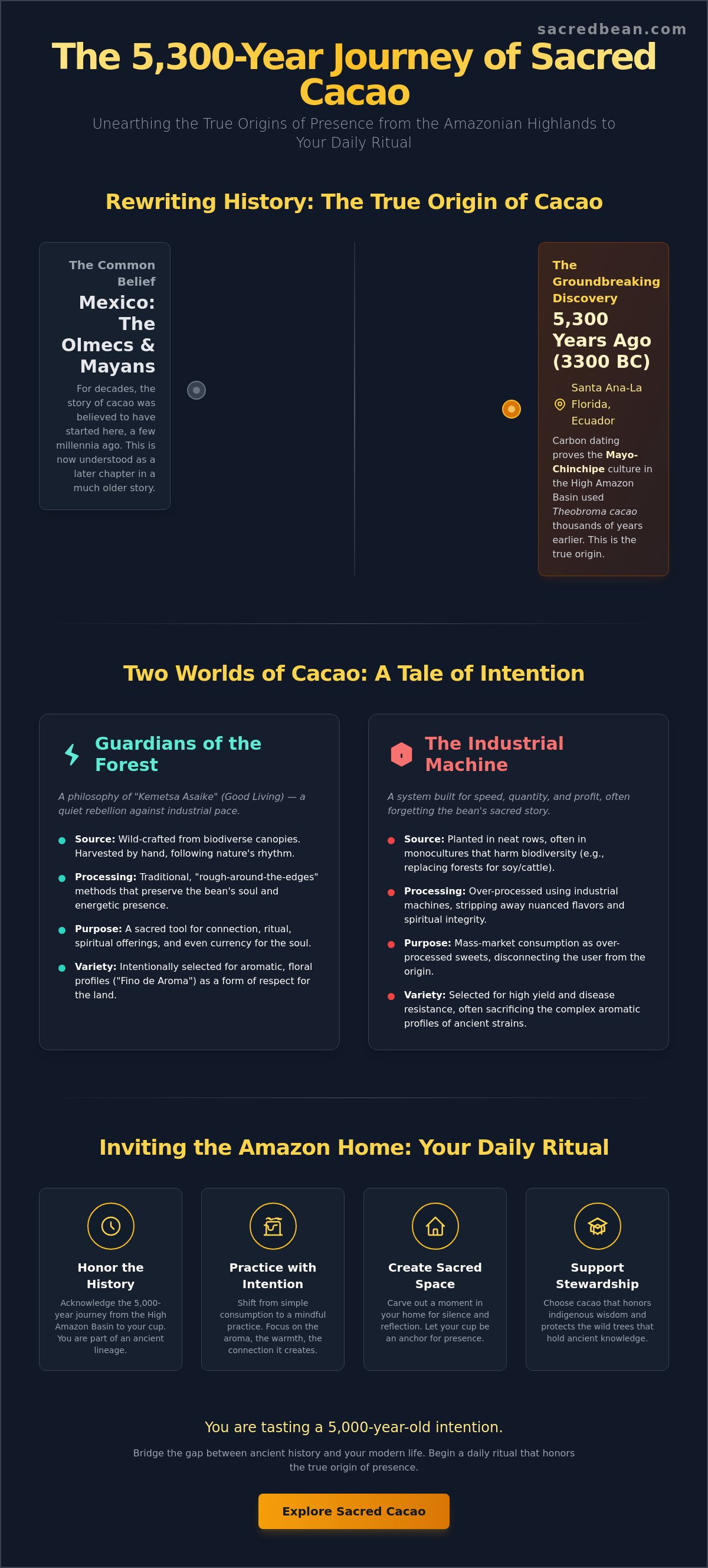
What if the presence you're searching for has been waiting in the soil for over five millennia? While many believe this story began in Mexico, carbon dating from 2018 at the Santa Ana-La Florida site proves that Amazonian cacao traditions actually took root 5,300 years ago in the Ecuadorian highlands.
It's easy to feel lost in a world of over-processed sweets, sensing a hollow gap where there should be connection. You know there's a deeper story behind the bean, one that commercial industries have long forgotten. We feel that same pull toward the origin, a desire to honor the hands and the history that make this bean sacred.
In this guide, we'll explore the ancient legacy of the Mayo-Chinchipe and the living wisdom of the Ashaninka people. You'll learn how to bridge the gap between ancient history and your own morning cup. By the end, you'll have a grounded way to start a ritual that honors 5,000 years of human transformation and presence.
Key Takeaways
- Uncover the 5,000-year history of the bean, tracing its sacred journey from the High Amazon Basin to your daily cup.
- Understand how indigenous stewardship acts as a quiet rebellion, protecting wild trees and ancient wisdom from the reach of industry.
- Explore why "rough-around-the-edges" traditional processing is the only way to keep the soul and presence of the bean intact.
- Deepen your daily practice by honoring Amazonian cacao traditions through a lens of intention rather than simple consumption.
- Learn to carve out a sacred space in your own home for reflection, silence, and a genuine connection to the origin.
The Origins of Presence: Unearthing the 5,000-Year History of Cacao
We used to believe the story started in Mexico. That was a half-truth. The real pulse of Amazonian cacao traditions began much deeper in the humid lungs of the High Amazon Basin. It’s a history of 5,300 years, not just a few millennia. This isn't just about a plant; it's about a bridge between the wild forest and human consciousness.
In the Santa Ana-La Florida site of southeast Ecuador, researchers found something that changed our lineage forever. They discovered that Theobroma cacao, the chocolate tree, was being used by humans long before the Olmecs or Mayans ever touched a pod. It’s a gritty, honest discovery that grounds our modern practice in a very old reality.
To better understand this concept, watch this helpful video:
The Mayo-Chinchipe Legacy in Ecuador
Archeologists unearthed pottery shards containing microscopic starch grains. This wasn't accidental. It was evidence of a sophisticated relationship with the plant dating back to 3300 BC. The Mayo-Chinchipe didn't just eat the fruit. They processed the seeds for burial rituals and traded them across the Andes.
The bean was a companion for the journey into the afterlife. It represented a transformation of the spirit. These ancient people recognized the sacred potential within the seed. The Mayo-Chinchipe were the original architects of cacao culture, weaving the bean into the very fabric of their spiritual and social existence.
Cacao as a Sacred Currency and Offering
In these ancient communities, the bean held a weight that gold never could. It was life-giving. It was a tool for connection. What started as a wild forest snack eventually transformed into a ceremonial beverage used to mark the most sacred moments of life and death. It was a currency of the soul.
Ancient selection processes favored what we now call the "Fino de Aroma" profile. These early guardians looked for the most aromatic, floral beans to fuel their Amazonian cacao traditions. They understood that quality was a form of respect for the land. When you hold a cup of ceremonial cacao today, you’re tasting a 5,000-year-old intention.
This history isn't just a collection of dates. It's a reminder of where we come from. It’s about a community that saw the divine in the dirt and the sacred in the seed. We're just the latest hands to carry this fire.
Guardians of the Forest: Indigenous Stewardship and Living Traditions
The Amazon isn't a museum. It's a living, breathing conscience. For the Ashaninka and Shuar peoples, the forest is a partner, not a resource to be mined. Their relationship with wild cacao trees goes beyond agriculture. It's a form of quiet rebellion. While industrial interests see the jungle as an obstacle to cattle ranching or soy monocultures, these communities see a sacred map. They've spent centuries protecting Amazonian cacao traditions that prioritize the health of the soil over the speed of the harvest. This stewardship is grounded in the concept of "Kemetsa Asaike," or "Good Living." It's a philosophy that rejects the frantic pace of the modern world. It teaches that the forest provides exactly what the soul needs when we approach it with respect. This isn't abstract theory. It's seen in the way they harvest, leaving enough for the animals and the earth to regenerate. To understand the depth of these practices, one can look at A Culture of Cacao and Chocolate, which highlights how these deep-rooted rituals have sustained communities for generations.The Ashaninka Way: Wild-Crafted Wisdom
The Ashaninka don't plant neat rows of trees. They harvest wild-growing cacao from within the biodiverse canopy. This method preserves the intricate balance of the ecosystem. Every pod is gathered by hand, following the rhythm of the seasons rather than a corporate calendar. They believe the tree is a teacher. We believe that direct relationships are the only way to ensure the integrity of what ends up in your cup. There's a grit and honesty in this process that machines can't replicate. You can learn more about these partnerships in our guide, Direct Relationship: Meet the Guardians of the Amazon.Protecting the Criollo Fino de Aroma
Since the 1960s, high-yield hybrids like CCN-51 have threatened to wipe out ancient varieties. These hybrids are bred for volume, but they lack the soul and complexity of the original Criollo Fino de Aroma. Traditional farming acts as a "Rainforest Shield." By maintaining these ancient trees, indigenous farmers prevent the encroachment of destructive industries. Supporting these regenerative practices is a moral choice. It keeps Amazonian cacao traditions alive while providing a buffer against deforestation. When you choose an authentic ceremonial cacaoThe Alchemy of the Amazon: Traditional Processing as Ritual
The journey from a heavy, colorful pod to a block of ceremonial cacao is a gritty, sensory transformation. It doesn't happen in a sterile lab. It happens in the humidity of the forest, where the air is thick with the scent of damp earth and ripening fruit. These Amazonian cacao traditions aren't about efficiency. They're about preserving the soul of the bean through a process that feels more like a slow, deliberate conversation with the land.
Traditional processing leaves the bean with its character intact. Industrial methods often strip away the natural fats and subtle notes to create a uniform, flat product. We prefer the rough edges. We want the grit. That texture is a reminder of the hands that turned the beans and the sun that dried them. It's where the alchemy lives.
The Five Steps of Traditional Transformation
- Step 1: The Harvest. We only select pods that are heavy and ripe. This isn't a mechanical sweep. It's a hand-picked selection where each pod is judged by its weight and the sound it makes when tapped by an experienced hand.
- Step 2: The Opening. Cracking the pod reveals the white, sweet pulp. It's a messy, tactile experience. This pulp is the lifeblood of the fermentation, surrounding the seeds with the natural sugars needed for the next phase.
- Step 3: Fermentation. This is where the flavor is born. For 5 to 7 days, the beans sit in wooden crates. The natural heat, often reaching 50 degrees Celsius, unlocks theobromine and complex aromas. It's a wild, microbial dance that defines the final character.
- Step 4: Sun Drying. The beans are spread on wooden decks under the equatorial sun. Farmers move them rhythmically with wooden rakes every 30 minutes. This ensures even moisture and captures the raw energy of the sun.
Beyond the Machine: The Human Touch
Industrial processing often kills the energetic frequency of the plant. High-speed grinders and chemical solvents destroy the delicate balance of the bean. Traditional methods are different. They honor the work of the forest guardians who have protected these trees for generations. This deep cultural history is explored in Chocolate in Mesoamerica: A Cultural History, which details how these ancient practices were never just about food, but about social and spiritual connection.
The master roaster's role is to finish what the forest started. It's a delicate dance of heat and timing that requires intuition rather than just a digital timer. The result of this patience is our Premium Criollo Fino de Aroma CEREMONIAL CACAO. It carries the weight of the Amazon and the hope of the people who harvest it. When you hold it, you aren't just holding a product; you're holding the result of a thousand small, intentional acts.
Ancient Rituals vs. Modern Presence: Finding the Connection
Most of us are conditioned for the "coffee break." It's a five minute dash to the kettle to fuel the next three hours of a high-pressure shift. It's transactional. We take from the bean to give to the grind. Amazonian cacao traditions offer a different rhythm entirely. These ancient practices weren't designed for a quick hit of energy. They were crafted for communal healing and finding clarity when the path forward felt dark.
There's a massive shift that happens when you stop consuming a product and start entering into a relationship with a plant. For us, this is the "reformed rebel" approach to wellness. We've seen the grit of life. We've felt the weight of struggle. Using a cacao ritual isn't about escaping reality; it's about building the internal strength to navigate it. It's a slow, intentional process that demands you show up exactly as you are.
In the Amazon, these traditions focused on the "we" as much as the "me." Healing wasn't a solo sport. It was a shared experience that cleared the mind and opened the heart. Today, we bring that same spirit to our modern lives. We use these moments of presence to stay grounded when the world feels chaotic. It's about reclaiming your time and your peace from a culture that wants you to move faster.
The Science of the Heart: Theobromine and Intention
The magic of this bean lies in theobromine. While caffeine triggers the nervous system and can lead to a 2:00 PM crash, theobromine offers a steady, cardiovascular lift. It dilates the blood vessels and improves blood flow without the sharp jitters. This gentle energy typically lasts between 6 to 8 hours, providing a sustained sense of alertness that feels supportive rather than aggressive.
This physical state is the perfect foundation for the emotional work of setting an intention. When your body feels calm and your heart is literally more open, you can focus on the transformation you want to see. You can dive deeper into this in our guide on Does Cacao Have Caffeine? Understanding Theobromine and the Cacao Energy. It's the difference between being wired and being awake.
Myth-Busting: Ceremonial Grade vs. Supermarket Powder
Don't be fooled by the labels in the baking aisle. The processed stuff you find in most stores is a distant, diluted relative of the sacred bean. To make those powders, manufacturers strip away the cacao butter. This natural fat is essential. It acts as the carrier for the spirit of the plant and ensures the nutrients are absorbed slowly by your body.
Real ceremonial cacao is unrefined. It's honest. It contains the full complexity of the bean, including that precious fat that gives the drink its thick, soul-warming texture. If it's been processed into a dry, lifeless powder, the integrity of the medicine is gone. We believe in keeping the bean whole because that's where the power lives.
Pure cacao doesn't need to be fixed or filtered; it just needs to be respected.
Inviting the Amazon Home: Creating Your Daily Cacao Ritual
Bringing a piece of the rainforest into your home isn't about luxury. It's about honesty. Your kitchen becomes a bridge to the Amazonian cacao traditions that have survived for over 5,300 years, dating back to the Mayo-Chinchipe culture. You don't need a golden altar or a perfect aesthetic. You just need a quiet corner and a willing heart. Clear the clutter from your counter. Put the phone in another room. Silence is the first ingredient in any real ritual. It creates the space for the plant to speak.
Grounding yourself starts with the feet. Stand firm on your floor. Feel the weight of your body. Think about the soil in Ecuador where these beans grew. This is a moment of connection between your modern life and the gritty reality of the earth. We use this time to step away from the grind and into a state of presence. It's a small rebellion against a world that demands constant speed.
The Simple Brew: A Guide to Preparation
Preparation is where the transformation begins. It's a tactile process. Take a moment to whisk your Premium Criollo Fino de Aroma CEREMONIAL CACAO POWDER with hot water. Keep the temperature around 70 degrees Celsius to preserve the vital compounds. Don't rush the stirring. Watch the bubbles form on the surface. This is 100 percent pure cacao, raw and potent.
The aroma hits you first. It's earthy, deep, and unapologetically bold. Breathe it in. This scent is your first step into the ceremony. It signals to your nervous system that it's okay to slow down. If you want a lighter experience for a mid afternoon pause, consider a cacao husk tea instead. It offers a gentle, clear infusion that still carries the spirit of the origin without the density of the full bean.
- Measure your cacao with intention.
- Whisk until the texture is smooth and frothy.
- Acknowledge the heat of the cup in your hands.
Setting Your Intention
Before the first sip, find your breath. Inhale the steam. Exhale the noise of your to-do list. This is where you set your intention. Keep it grounded. You might say, "I am present." You might need to feel, "I am resilient." These simple phrases connect your mind to the ancient forest. By honoring these Amazonian cacao traditions, you participate in a cycle of redemption and hard work.
Every sip supports a larger story. It's a story of farmers in the Napo province who protect the biodiversity of the land. It's about the hands that harvested, fermented, and dried these beans under the sun. When you finish your cup, take ten seconds to feel gratitude. Thank the earth. Thank the producers. This ritual isn't just for you. It's a shared journey of many hearts, moving from the shade of the canopy to the warmth of your mug. You leave the ritual not just refreshed, but connected to something much bigger than yourself.
Claim Your Moment of Presence
The 5,000 year history of these forests isn't just a story from the past. It's a living, breathing connection that we carry into our modern lives. When you sit with this medicine, you're honoring the indigenous guardians who have protected these trees for generations. These Amazonian cacao traditions remind us that presence isn't something we find; it's something we build, one intentional sip at a time.
Chef Pablo Aguilar founded Sacred Bean to honor this traditional alchemy. We don't settle for anything less than purity. Our beans are directly sourced from the Ecuadorian Amazon and third-party lab tested for heavy metals. It's about honesty, integrity, and the grit to choose a slower pace. Every cup is an invitation to step out of the noise and back into yourself.
You're not just drinking a beverage. You're participating in a cycle of recovery and respect that spans continents and centuries. This is about making space for transformation in the middle of the daily grind. It is a sacred act of reclaiming your own time.
Experience the lineage with our Premium Criollo Fino de Aroma CEREMONIAL CACAO
The journey back to your own center starts with a single intention. We're here to walk that path with you. Stay grounded and keep seeking the light.
Frequently Asked Questions
What is the main difference between Amazonian cacao and regular chocolate?
The main difference lies in the integrity of the bean and the lack of industrial processing. Commercial bars often strip away healthy fats and add 50% refined sugar. Our ceremonial cacao remains a whole food. It retains the natural butter and the complex spirit of the soil. This keeps the experience grounded in presence. No sugar spikes. Just honest connection.
How did ancient Amazonian cultures traditionally consume cacao?
Ancient cultures prepared it as a warm, frothy beverage mixed with water and local spices like chili or vanilla. They didn't see it as a sweet treat. It was a tool for connection and spiritual focus. Archaeologists found residue in ceramic vessels dating back over 5,000 years. It was a staple of communal life and sacred rites. A drink for the brave.
Why is the Mayo-Chinchipe culture significant to cacao history?
The Mayo-Chinchipe culture provides the earliest evidence of cacao use, dating back to 3300 BC in the Santa Ana-La Florida site. This discovery shifted the known history of the bean by 1,500 years. It proved that Amazonian cacao traditions began in the upper Amazon of Ecuador. Their legacy is a testament to the long journey of human transformation and the sacred bond with the land.
Can I perform a cacao ceremony at home without a facilitator?
You can absolutely create a personal ritual in your own space. It's about your own intention and the quiet honesty you bring to the cup. Start by setting aside 20 minutes of silence. Sip slowly. Focus on the warmth and the earthy taste. This simple act of presence is the heart of the ceremony. It's a second chance to connect. No facilitator needed.
What does "Fino de Aroma" mean in the context of Amazonian traditions?
Fino de Aroma is a classification by the International Cocoa Organization that describes beans with exceptional floral and fruity profiles. Only 5% of the world's bean production receives this label. In the context of Amazonian cacao traditions, it represents the Arriba Nacional variety. This bean is a symbol of the rich heritage and the gritty work of local farmers who preserve these ancient genetics.
Is ceremonial cacao the same as raw cacao powder?
No, ceremonial cacao is a whole bean paste, while powder has been stripped of its natural fats. The process of making powder involves high-pressure hydraulic presses that remove about 75% of the cacao butter. Our tradition keeps the fat intact because it carries the nutrients and provides a steady, grounded energy. It's the difference between a fragmented product and a complete, sacred experience.
How do Amazonian cacao traditions support rainforest conservation?
These traditions rely on Chakra systems, which are diverse agroforestry gardens that mimic the natural forest. By choosing these methods, farmers protect over 100 different plant species within a single hectare. This prevents the 13% deforestation rate seen in industrial monocultures. Supporting these Amazonian cacao traditions means investing in the redemption of the land and the people who guard it. It's a path of restoration.
What is the best time of day to engage in a cacao ritual?
Most people find that the early morning, around 6:00 AM, is the most potent time for a ritual. Your mind is clear and the world is still quiet. It sets a tone of mindfulness for the rest of your day. However, any time you feel the need for a moment of connection or a reset is the right time. Listen to your own rhythm. Trust your gut.