

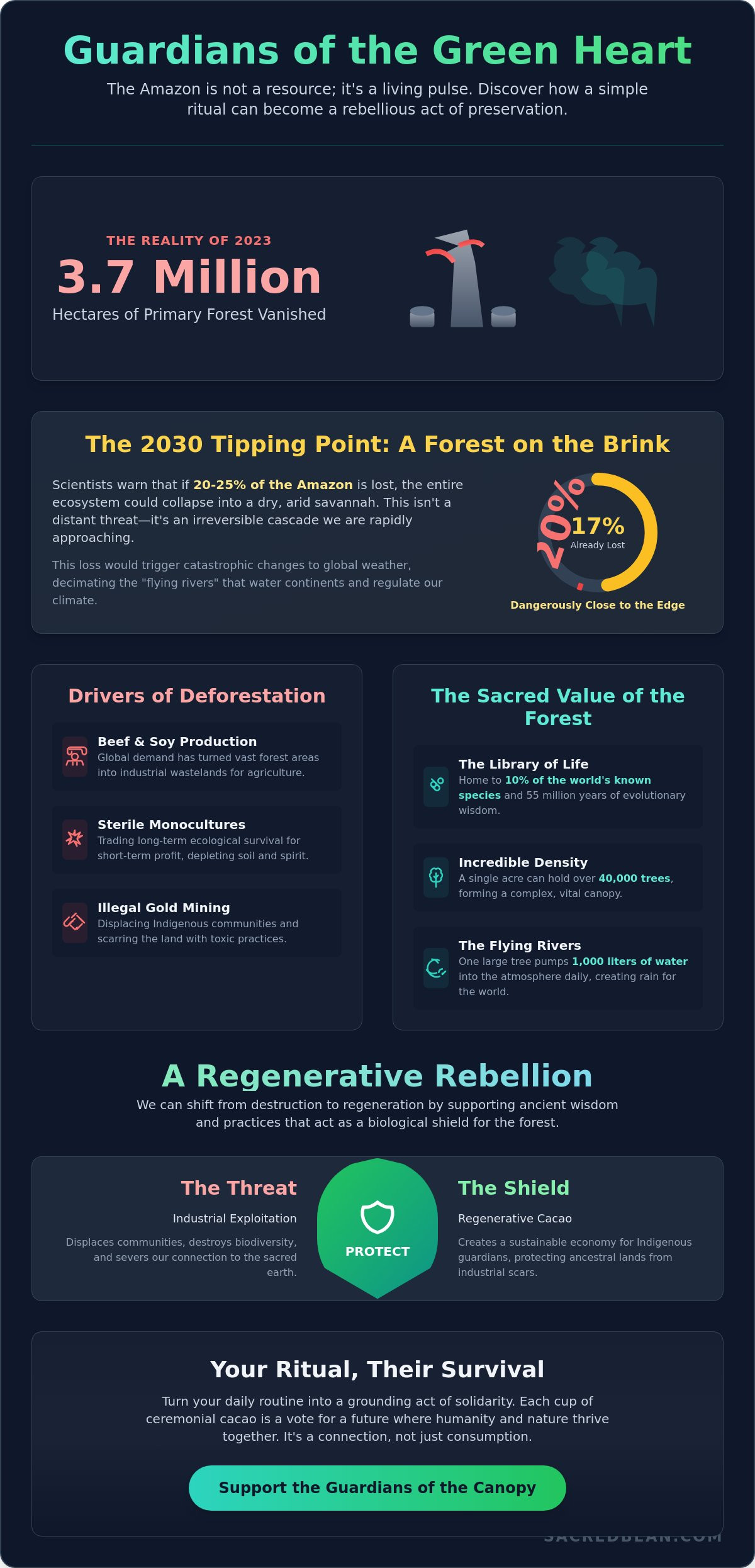
A single acre of primary forest can hold over 40,000 trees, yet the world watched as 3.7 million hectares of this vital canopy vanished in 2023. It’s a staggering reality that often leaves us feeling paralyzed by a heavy, quiet eco-anxiety. You’ve likely felt that weight, wondering if protecting the Amazon rainforest is even possible when corporate greenwashing feels so loud.
It’s easy to feel disconnected from the source of the products we use every day. We know that deep down, you want more than just a transaction; you’re looking for a genuine way to stand with the land and the people who guard it. You deserve a path that feels honest and grounded in real, gritty transformation.
This article shows you how the ancient wisdom of Indigenous guardianship and the practice of a cacao ritual offer a powerful, regenerative solution for our planet’s future. We’re moving beyond simple donations to find a deeper sense of grounded hope through the spirit of ceremonial cacao from Ecuador.
We’ll explore the reality of forest preservation and how your daily intentions can support the sacred work of local communities. It’s time to discover a path to global redemption that starts with connection, not just consumption.
Key Takeaways
- Shift your perspective from viewing the Amazon as a resource to seeing it as a living, sacred pulse that demands our solidarity.
- Face the gritty reality of the 2030 tipping point and learn why protecting the Amazon rainforest is a race against time for our global climate.
- Discover how regenerative ceremonial cacao serves as a biological shield, protecting ancestral lands from the scars of industrial mining.
- Learn to turn your morning routine into a grounding cacao ritual that connects your personal intention to the survival of the forest.
The Living Pulse: Why Protecting the Amazon Rainforest is Personal
We often hear the Amazon called the "lungs of the planet." It is a nice image, but it feels too clinical and detached. For us at Sacred Bean, this forest is a living, breathing community of spirits and species. It is the heartbeat of our origin. Protecting the Amazon rainforest isn't a corporate checkbox; it's an act of global redemption for a world that has lost its way.
We don't see the forest as a resource to be mined. We see it as a teacher. Our modern world has traded presence for profit, and that disconnection is the primary reason the forest is in pain. It's a mirror of our own internal struggles. By protecting the Amazon rainforest, we are actually working on our own recovery and learning to value what is sacred again.
The truth is gritty. We are facing a reality of Amazon deforestation that puts the entire ecosystem at a tipping point. Scientists suggest that if 20% to 25% of the forest is lost, the whole system could collapse into a dry savannah. This isn't just a local tragedy. It affects every breath we take and the very soil where our cacao grows.
To better understand this concept, watch this helpful video:
The Library of Life: Biodiversity Beyond Statistics
Imagine standing under the emerald roof of the Ecuadorian jungle. The air is thick with the scent of damp earth and blooming orchids. The canopy is a hum of life where you can feel the vibration of millions of insects and birds. This space holds 10% of the world's known species, each playing a role in a complex, holy balance.
When an acre is cleared, we don't just lose trees. We lose ancient evolutionary wisdom that took 55 million years to write. Every lost acre is a lost chapter of medicine, history, and ecological resilience. The Amazon is a living library of biological secrets that we are currently burning to the ground.
Flying Rivers: How the Forest Waters the World
The forest creates its own weather through a process called evapotranspiration. It is a beautiful, invisible labor. A single large tree can pump 1,000 liters of water into the atmosphere every day. These "flying rivers" carry moisture across continents, influencing rainfall patterns as far away as the United States and Europe.
This sacred cycle of water binds the Ecuadorian forest directly to the crops and communities in your own backyard. It is a testament to our radical interconnectedness. When you sit with a cup of ceremonial cacao, you are tasting the result of this massive, global irrigation system. When we protect the source, we protect our shared future.
The Tipping Point: Facing the Gritty Reality of 2026
2026 isn't a distant date on a calendar. It's a mirror. We're looking at a landscape scarred by illegal gold mining and the relentless hum of chainsaws. This is the gritty reality of "business as usual." Scientific data from 2023 suggests we are hurtling toward a 2030 tipping point. That is the moment the humid forest begins its irreversible shift into a dry savannah.
This isn't a funeral march. It's a rebellion of the conscience. We refuse to accept the silence. Protecting the Amazon rainforest is about more than carbon credits. It's about preserving the heartbeat of our planet. The Amazon rainforest is one of Earth's most vital ecosystems, yet we often treat it like an infinite warehouse. We have a choice to make before the clock runs out.
The Cost of Convenience: Beef, Soy, and Monocultures
How did we get here? It started with the plate. Global demand for beef and soy has turned 17 percent of the basin into industrial wasteland. We see the contrast clearly. On one side, the sacred diversity of the natural forest. On the other, the sterile, silent rows of monoculture crops. This trade-off trades our long-term survival for quarterly dividends. It's a hollow victory that leaves the soil depleted and the spirit thin.
The Silence of the Canopy: When Wisdom is Lost
The trees aren't the only things falling. When the forest recedes, the ancient wisdom of its guardians fades too. Indigenous communities are being displaced by land grabbers at an alarming rate. Protecting the Amazon rainforest means protecting the stories and rituals of the people who know it best. There is a heavy spiritual weight in losing a species that never even received a name. Every lost plant is a lost possibility for healing.
We find our own small way to reconnect through presence and intention. When we choose ceremonial cacao, we're supporting a different path. It's a path rooted in origin and community rather than extraction. It's a small act of redemption in a world that needs it. We believe in the power of a conscious choice to spark a larger transformation.
Guardians of the Canopy: Why Indigenous Wisdom is the Shield
The data is undeniable. A 2021 report by the FAO and FILAC confirmed that deforestation rates in Indigenous territories are up to 50% lower than in surrounding areas. We've spent decades talking about "saving" the forest. It's time to shift that narrative. Our role isn't to play the hero. It's to stand in solidarity with the people who have been protecting the Amazon rainforest for thousands of years. These communities are the front line. They're the true shield against destruction.
There's a gritty, "reformed rebel" spirit in these territories. Indigenous leaders often risk their lives to defend their borders against illegal mining and logging operations. They fight for land rights against overwhelming odds. This isn't a polished corporate campaign. It's a raw, human struggle for survival. When we support them, we aren't just donating to a cause. We're joining a resistance. We're backing those who refuse to let the sacred be sold for parts.
Traditional Ecological Knowledge (TEK) in Action
Ancient practices keep the ecosystem whole. For these communities, the forest isn't a resource to be extracted or a wilderness to be tamed. It's a garden. They've spent generations learning how to cultivate food, medicine, and fiber without leaving scars on the earth. They understand the rhythm of the rain and the language of the soil. Indigenous land management outperforms modern technology in conservation because it's rooted in a deep, spiritual relationship with the land rather than distant data points or satellite imagery.
- Forest gardens mimic natural structures to maintain biodiversity.
- Rotational planting allows the earth to breathe and recover.
- Knowledge is passed down through story and ritual, ensuring long-term stewardship.
A Direct Relationship: From Ecuador to Your Heart
Origin is everything. When you prepare your ceremonial cacao, you're connecting with a specific piece of earth and a specific family. We source through the Guardians of the Amazon because we believe in transparency. This isn't about charity. It's about a community-driven model of transformation. Direct trade provides the financial armor Indigenous communities need to defend their borders and sustain their way of life.
Knowing the hands that touched your cup creates a profound connection. It moves us beyond the sterile transaction of modern commerce. This relationship is built on mutual respect and shared intention. By choosing products that honor their origin, you're directly contributing to protecting the Amazon rainforest. It's a path of redemption. It's a way to turn a daily habit into an act of conscience. We're building a bridge from the heart of the jungle to your own, one bean at a time.
Regenerative Cacao: How Your Ritual Becomes a Rebellious Act
Industrial farming is a scar on the face of the earth. It demands silence and submission from the land, stripping away the wild to make room for rows of identical, fragile plants. But there's a different way. Choosing ceremonial cacao grown in the heart of the jungle isn't just a lifestyle choice. It's a shield. When you reach for heritage Criollo Fino de Aroma, you're voting for a standing forest over a scorched field.
Most commercial "chocolate" comes from monocultures that bake in the sun, reliant on chemicals to survive. Regenerative cacao is different. It's a rebel. It thrives in the shade, nestled under the canopy of ancient mahogany and cedar trees. This method, known as agroforestry, means the forest stays intact. Farmers aren't clearing the land; they're weaving the cacao into the existing tapestry of life. This is the front line of protecting the Amazon rainforest.
- Agroforestry mimics the natural structure of the jungle.
- It prevents the erosion that turns fertile ground into dust.
- It creates a corridor for wildlife, from jaguars to iridescent bees.
- The trees provide a diverse income for families beyond a single crop.
Healing vs. Heating: The Alchemy of Soil
The science is as grounded as the dirt itself. A cleared field is a source of carbon, bleeding heat into the atmosphere. A cacao forest is a carbon sink. Research shows that these diverse agroforestry systems can sequester up to 2.5 tons of carbon per hectare every year. The roots reach deep, pulling life back into the earth and holding it there. This isn't just about the atmosphere; it's about the integrity of the soil.
The "sacred" essence of this plant is inseparable from the health of the ground it grows in. If the soil is tainted, the medicine is lost. We prioritize the ceremonial cacao powder that comes from these pristine environments. Clean soil means a clean spirit. It's why we look for low cadmium levels as a marker of purity. When the land is respected, the plant rewards us with its true, unburdened power. We're part of a cycle of redemption for the earth.
The Zero-Waste Forest: Using the Whole Fruit
Nature doesn't understand the concept of trash. In the Amazon, every piece of the harvest has a purpose and a place. The forest is a closed loop of energy and resilience. We follow that lead. Utilizing the entire fruit is how we honor the land's abundance rather than just extracting what's profitable. It's a lesson in humility and forest efficiency.
The organic cacao husk tea is the perfect example of this philosophy. These husks are often discarded in industrial processing, but they hold a delicate, earthy strength. Brewing them is a ritual of connection. It's a way to sip the forest's resilience and ensure nothing is wasted. By supporting protecting the Amazon rainforest through zero-waste practices, we acknowledge that every part of the tree is a gift. It's a small act of rebellion against a throwaway culture.
Take a stand for the standing forest and bring the spirit of the Amazon into your home.
Beyond the Cup: Cultivating a Sacred Connection to the Source
The morning air feels different when you approach it with intention. Instead of a rushed caffeine fix, your routine can become a cacao ritual of deep presence. This isn't about a quick energy boost. It's about a slow, grounded connection to the earth. When you whisk your ceremonial cacao powder, you're engaging in a practice that honors the land.
Every sip you take is a direct vote for the forest's survival. It is a choice to support ecosystems rather than industrial monocultures. As the warmth spreads, take a moment of stillness. Set a clear intention for protecting the Amazon rainforest. Visualize the roots holding the soil and the canopy breathing out the world's oxygen. This simple act moves you from a gritty understanding of the threats to a sacred commitment to action.
The journey of redemption starts with these small, honest moments. We've moved past the data and the maps. Now, it's about the heart. It's about the realization that our daily choices ripple across the globe. We aren't just consumers; we are stewards of a legacy that began long before us.
Choosing Origin Over Convenience
True change requires us to look past the bright packaging on grocery store shelves. Practical rebellion starts with reading labels. Seek out "Criollo Fino de Aroma" as your quality standard. This designation accounts for only the top 5 percent of global cacao production, ensuring a focus on heritage and flavor over mass-market volume. Your conscience has the power to shift global demand away from destruction.
Supporting small, ethical brands is a quiet but fierce rebellion. It rejects the convenience of industrial farming that strips the land of its soul. By choosing transparent origins, you ensure that protecting the Amazon rainforest is built into the price of the bean. It's a way to ensure the farmers are seen and the soil is respected.
The Sacred Bean Promise
We live by the philosophy of "Roasting for Redemption." This is our final reflection on the beauty of transformation. We believe that something broken can be made whole again. Whether it's a person seeking a second chance or a forest fighting for its life, the potential for renewal is always present. Every individual has inherent value, just like every tree in the basin.
We invite you to join this community of reformers and dreamers. We don't need more corporate jargon; we need more human connection. The work is hard, and the path is often gritty, but the results are beautiful. The forest breathes because we choose to remember it. Together, we can ensure that this sacred source remains for those who come after us.
A Sacred Choice for a Living Future
The clock is ticking toward the 2026 tipping point. We can't afford to look away from the gritty reality of the canopy. The path forward isn't found in corporate boardrooms. It's held in the hands of the Ecuadorian Indigenous guardians who have protected this land for generations.
By choosing regenerative agroforestry, we move beyond consumption and into a state of active restoration. Every cup of 100% pure Criollo Fino de Aroma is a vote for the soil. It's a commitment to a lineage of wisdom that refuses to be erased. We're reclaiming our connection to the source, one intentional ritual at a time.
This is how we begin protecting the Amazon rainforest through our daily choices. It's a small act with a massive heart. The forest doesn't need our pity; it needs our solidarity. We invite you to step into this circle of redemption and hope. Your morning ritual can be a rebellious stand for the earth.
Join the movement and protect the forest with every sip of our Ceremonial Cacao
Frequently Asked Questions
How does buying ceremonial cacao help in protecting the Amazon rainforest?
Choosing ceremonial cacao helps in protecting the Amazon rainforest by creating a financial lifeline for the people who live there. When native trees provide a sustainable income, there's no need to clear the land for cattle or soy. We believe this is a path of redemption. It turns a simple daily habit into a fierce act of conservation that keeps the canopy intact and the soil healthy.
What is the "tipping point" of the Amazon and why is 2026 a critical year?
The tipping point is the threshold where the rainforest can no longer produce its own rain, potentially turning 50% of the basin into a dry savanna. Scientists from the Science Panel for the Amazon warn that reaching 20% to 25% total deforestation will trigger this collapse. Since current loss sits near 17%, the next few years leading to 2026 are a final window to halt the damage.
Why are Indigenous peoples considered the best guardians of the rainforest?
Indigenous communities are the most effective guardians because their traditional knowledge maintains the land's ecological balance. Data from the World Resources Institute shows that deforestation rates are 50% lower on tenured Indigenous lands compared to other areas. Their presence creates a physical and legal barrier against land grabbers, ensuring the forest remains a living sanctuary rather than a commodity for the highest bidder.
What is the difference between forest-grown cacao and industrial chocolate monocultures?
Forest-grown cacao thrives under a diverse canopy of native trees, while industrial monocultures require clear-cutting the land for sun-drenched rows. In a regenerative system, cacao is part of a complex web involving over 100 different plant species per hectare. This approach preserves the soil's soul. It's the difference between a sterile factory and a vibrant, breathing ecosystem that supports life and captures carbon.
Can I really make a difference from home in Canada or the US?
Your choices in North America dictate which supply chains survive and which ones wither. By choosing transparently sourced ceremonial cacao, you're participating in a global act of redemption from your own kitchen. Every dollar spent on forest-positive products acts as a vote for a living Amazon. It's a small, daily ritual that fuels the resistance against industrial destruction and corporate greed while supporting remote families.
What are "flying rivers" and how do they affect my local weather?
Flying rivers are massive plumes of water vapor released by rainforest trees that travel across continents to produce rainfall. A single large tree can pump 1,000 liters of water into the atmosphere every day. This moisture regulates the climate and supports agriculture as far away as the Great Plains in the US and the Canadian prairies. Without them, our global food systems face total collapse.
Is regenerative agroforestry enough to stop deforestation?
Regenerative agroforestry is a powerful tool for restoration, but it must be paired with strict legal protections and land rights. It allows us to heal 1.5 million hectares of degraded land in the Amazon by mimicking natural forest layers. While it won't stop a bulldozer on its own, it provides the economic resilience families need to keep those bulldozers away for good. It's about building a defense.
How can I tell if my cacao is ethically sourced from the Amazon?
You can verify your cacao's ethics by looking for specific origin details and stories of the hands that grew it. Truly ethical brands name the specific community in Ecuador and share the journey of the beans. Transparency isn't a marketing buzzword; it's a commitment to honesty. If a brand can't tell you who harvested the pods, it's likely disconnected from the land's spirit and the people's struggle.