

We get it. The chocolate aisle is a loud place, filled with shiny wrappers and hollow promises. That term, ‘bean to bar,’ gets thrown around until it almost loses its meaning. Is it just another label designed to make you pay more? Or is it a promise? For us, it’s a sacred commitment. The authentic bean to bar chocolate process isn't a marketing slogan; it's a gritty, beautiful journey of transformation, one that connects the farmer, the maker, and you.
Forget the confusion and the corporate jargon. We're pulling back the curtain to show you the honest truth. In the steps that follow, we’ll walk you through that entire sacred journey-from the raw cacao pod to the finished, soulful bar. You’ll discover the craft, understand the flavor, and gain the confidence to choose chocolate that aligns with your conscience. This is more than just a recipe; it’s the story of how something humble is redeemed into something beautiful.
Key Takeaways
- Learn why 'bean to bar' is more than a label-it's a gritty philosophy of transparency and craft that honors the cacao's true origin.
- Uncover the authentic, step-by-step bean to bar chocolate process and see what separates real, soulful craft from mass production.
- Discover the science behind the perfect 'snap' and understand why tempering is a non-negotiable step for creating truly exceptional chocolate.
- Connect the chocolate-making journey to a deeper purpose and see how every step can honor the transformation within the bean and the maker.
The Seed of It All: What 'Bean to Bar' Truly Means
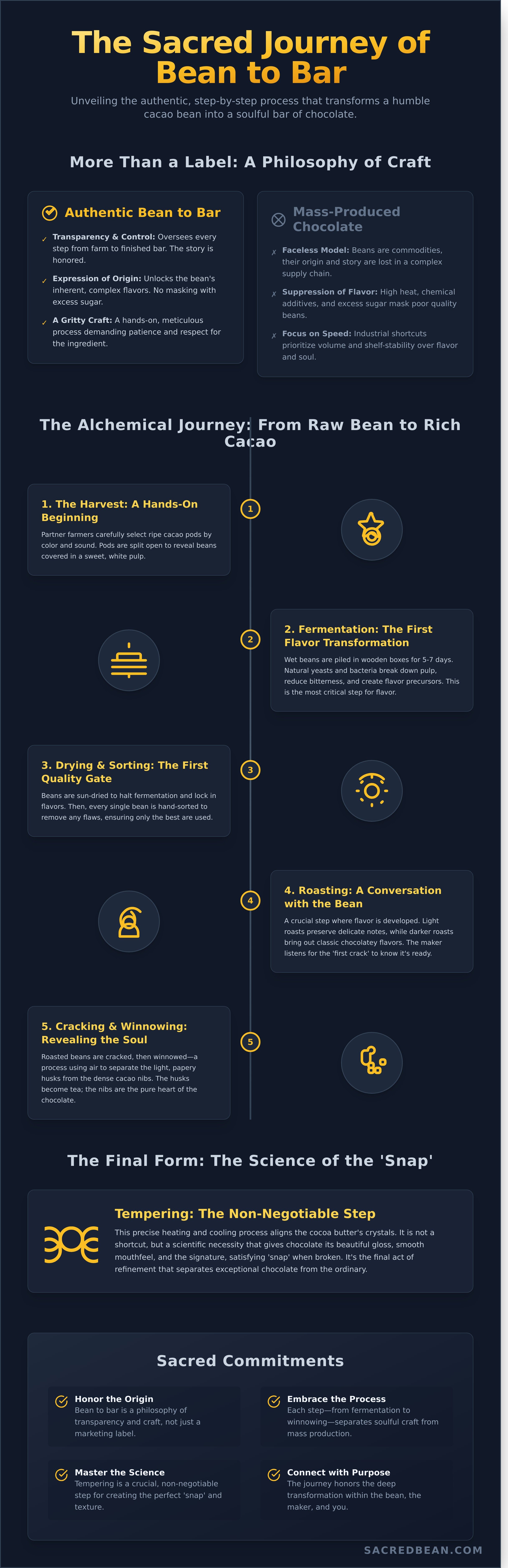
Bean to bar isn’t just a label. It’s a conviction. A gritty, hands-on philosophy of transparency and control that connects the soil to the soul. It’s our promise to oversee every sacred step of the bean to bar chocolate process, from the farm to the finished bar in your hands. This is a rebellion against the faceless industrial model, where beans are just commodities and the story of their origin is lost. For a deeper dive into the movement, it's worth understanding What is Bean-to-Bar Chocolate? as a foundation for this craft.
To see a part of this intricate journey in action, the video below shows the careful process of tempering:
Everything we do begins with the Theobroma Cacao tree-literally, "food of the gods." Our entire mission is built around this origin. We don't see our job as masking the bean's inherent character with excessive sugar or additives. We see it as a sacred trust: to unlock and reveal the bold, honest, and complex flavors the earth and the farmers worked so hard to create. It’s about expression, not suppression.
The Harvest: A Hands-On Beginning
It all starts with human hands. Our partner farmers walk the groves, selecting each cacao pod with practiced care. They know a pod is ready not just by its vibrant color-a deep yellow, orange, or red-but by the hollow sound it makes when tapped. A sharp machete frees the pod from the tree. It’s then split open, revealing the treasure inside: a cluster of beans covered in a sweet, white pulp.
Fermentation: The First Flavor Transformation
This is where the magic begins. Fermentation is arguably the most critical step in the entire bean to bar chocolate process, creating the very precursors to the flavors we love. The wet beans are piled into wooden boxes or heaps and covered with banana leaves. For the next 5-7 days, natural yeasts and bacteria go to work, generating intense heat that breaks down the pulp, reduces bitterness, and sparks the first profound transformation of flavor.
The Alchemical Journey: From Raw Bean to Rich Cacao
This is where the real transformation begins. The raw cacao arrives at our door, carrying the story of its soil and the hands that harvested it. While the farm's fermentation process lays the groundwork for flavor-a complex topic you can explore in The Science of Bean-to-Bar Chocolate-our work is to honor that potential. It's a gritty, hands-on journey from a humble seed to something sacred.
Step 1: Drying & Sorting
First, we ensure the beans are perfectly dried under the sun, a crucial step to halt fermentation and lock in the developing flavors. Then comes the real test of conscience: hand-sorting. We inspect every single bean, removing any that are broken, flat, or flawed. It’s a slow, meticulous process, but it’s our first quality gate. A promise that only the best beans make it through, ensuring a pure, honest taste in the final bar.
Step 2: Roasting
This is where the magic happens. Roasting is a conversation with the bean. We don't follow a rigid formula; we listen, watch, and smell. A light roast might preserve delicate floral or fruity notes, while a darker roast develops those deep, classic chocolatey flavors. The whole workshop fills with a rich, brownie-like aroma as the beans tumble, and then we hear it: the 'first crack.' A quiet pop that signals the flavor is truly awakening. This is the heart of the bean to bar chocolate process, where we guide the bean toward its final expression.
Step 3: Cracking & Winnowing
Once cooled, the roasted beans are fragile shells protecting a precious core. We gently crack them into smaller pieces, breaking them open to reveal the treasure inside. Then, in a process called winnowing, we use air to separate the light, papery husks from the dense, rich cacao. Nothing is wasted here. The husks become a beautiful, delicate organic cacao husk tea. What remains is the pure, unadulterated soul of the chocolate: the cacao nibs.
The Art of Refinement: Crafting Flavor and Texture
So, isn't all chocolate made this way? In a word, no. This is where the path splits. Where mass production takes shortcuts with high heat and chemical additives, the craft bean to bar chocolate process demands patience. It requires a steady hand and a deep respect for the bean. This isn’t about speed. It’s about transformation-coaxing out the soul of the cacao, not just processing it.
This is where the real work of developing flavor and texture begins, turning a raw ingredient into something sacred. It's a testament to the idea that true quality can't be rushed.
Grinding & Melanging
It starts by breaking things down to build them back up. We pour our roasted cacao nibs into a stone grinder, or melanger. For hours, heavy granite wheels turn, crushing the nibs with relentless friction. This isn't just brute force; the heat generated melts the cocoa butter, releasing it from the solids and transforming the gritty nibs into a smooth, flowing liquid. This is pure cacao liquor-the honest, unadulterated foundation of everything we create. It’s the same sacred base we use for our ceremonial cacao powder, a testament to its raw power.
Conching: The Secret to Smoothness
Next comes the vigil. Conching is a long, slow process of agitating, mixing, and aerating the liquid chocolate. It’s our commitment to true refinement. This crucial step does two things: First, it drives off any remaining harsh, acidic notes, allowing the deeper, more complex flavors to emerge. Second, it polishes every particle of sugar and cacao until the texture is impossibly smooth. Industrial chocolate might get a few hours. Ours gets days. There are no shortcuts to a silky texture or a redeemed flavor profile.
These steps are about subtraction, not addition. We’re not adding fillers, emulsifiers, or artificial flavors to mask a mediocre bean. We are carefully refining what’s already there, honoring the farmer’s work and the bean’s inherent character. It’s a gritty, beautiful, and absolutely essential part of our bean to bar chocolate process and our commitment to making chocolate with a conscience.
The Final Form: Tempering, Molding, and Why It Matters
After all the grinding and refining, the chocolate is a gritty, liquid soul. But it’s not yet whole. This final stage is about giving it structure. A body. This is where patience and precision transform potential into something sacred. It’s the last, crucial step in our bean to bar chocolate process, where science and intention meet.
The Science of Tempering
Tempering isn't just a technique; it's a discipline. In simple terms, we're convincing the cocoa butter crystals to align, to find their strength in a stable, unified form. It’s a delicate dance of heating and cooling-melting away old habits, then carefully guiding the chocolate into a new, resilient structure. The result is a bar with a confident sheen and a clean, defiant snap. Untempered chocolate? It’s dull, crumbly, and melts in your hand. It's a story of a process cut short.
Molding & Wrapping: The Final Touch
Once tempered, we pour the liquid chocolate into its final form. Each mold is a promise fulfilled. But the journey isn't over. We wrap each bar by hand, not just for looks, but for protection. This final shield guards the deep, honest flavors we’ve worked so hard to build, keeping out light and air. It preserves the craft and ensures that what you unwrap is exactly what we intended.
People sometimes ask why our chocolate costs more. This is why. Because every single step matters. There are no shortcuts in redemption, and there are none in real chocolate making. The entire bean to bar chocolate process is a testament to a slower, more intentional way of doing things. You’re not just paying for a treat; you’re investing in a craft, a story of transformation, and a product made with conscience. That's the integrity we stand by. That's the difference you can taste.
Experience the Journey: How Sacred Bean Honors the Process
We’ve walked you through the nuts and bolts of our work. The sorting, the cracking, the conching. But to truly understand Sacred Bean, you have to look past the machinery. Our bean to bar chocolate process is guided by a single, unwavering principle: to honor the cacao, not just process it. This isn't a sterile production line. It's a conscious act of stewardship, a gritty and honest path from the soil to your soul.
We fight to protect the spirit of the bean. In a world that prizes speed and efficiency, we choose patience and intention. Our minimalist approach is a rebellion against over-processing. We believe the true power of cacao lies in what’s already there. Our work is to preserve, not to alter. To deliver a final product that is:
- Pure: Free from unnecessary additives and distractions.
- Potent: Retaining its full spectrum of nutrients and theobromine.
- Alive: Charged with the energy of its journey and its purpose.
From Our Farmers to Your Cup
Our process begins with a handshake and a shared belief. It starts with our direct relationships with farmers who cultivate the legendary Criollo Fino de Aroma cacao using sustainable, earth-honoring practices. This isn't just about "sourcing." It's about a partnership built on mutual respect and a fair exchange. This ethical foundation is the first, non-negotiable step in our bean to bar chocolate process, ensuring the spirit of redemption and integrity is woven in from the very beginning.
The Sacred Bean Difference
Our small-batch method is our commitment to you. It means we can give our full attention to every single stage, listening to what the beans need. This isn't for efficiency; it’s for integrity. We are preserving the soul of the cacao so it can arrive ready for your personal ceremony. The result isn't just a block of chocolate. It's an invitation. A tool for grounding, for opening the heart, and for deep transformation. It’s a reminder that something sacred can come from a simple, honest process.
This is the culmination of our work-a pure, potent expression of the cacao's spirit. Ready for you. Taste the culmination of this sacred journey with our Ceremonial Cacao.
More Than Chocolate: A Transformation You Can Taste
The journey from a single cacao seed to a finished bar is a sacred one. It’s a gritty, hands-on testament that true quality is never rushed and that real transformation requires patience and intention. Understanding the full bean to bar chocolate process reveals the soul behind the flavor-a deep respect for the raw ingredient and the people who nurture it. This isn’t about mass production; it’s about honoring an ancient craft, step by painstaking step.
This is the path we walk at Sacred Bean. Our conscience is in our craft. We honor this journey by using only premium Criollo Fino de Aroma cacao, ethically sourced directly from farmers. Every small, artisanal batch is a story of redemption. A piece of hope you can hold. We invite you to be part of it, to taste the difference that integrity makes.
Experience the purity of a true bean-to-bar process. Shop our Sacred Cacao. Choose a chocolate that stands for something more.
Frequently Asked Questions
What is the difference between bean-to-bar and regular store-bought chocolate?
Bean-to-bar is about honesty. It’s a commitment to the entire journey, from the sacred cacao bean to the finished bar. We control every step-sourcing, roasting, grinding-to honor the bean's true flavor. Most store-bought chocolate is mass-produced, often with fillers and less-than-transparent sourcing. Our process is a rebellion against that anonymity. It's about knowing the story, the hands, and the heart behind what you eat. It’s chocolate with a conscience.
How long does the entire bean to bar chocolate process take?
True transformation takes time. From the moment the cacao pods are harvested, it can take several weeks to create a single bar. Fermentation and drying at the farm alone can last up to two weeks. Once the beans reach our workshop, our small-batch bean to bar chocolate process-roasting, grinding, conching, and aging-adds another three to five days of patient, hands-on work. There are no shortcuts to redemption, and there are no shortcuts to real chocolate.
Is bean-to-bar chocolate healthier than other chocolate?
We believe in honest ingredients. Bean-to-bar chocolate is typically healthier because it’s made with a simple, pure list of ingredients: cacao and a touch of sugar. The quality of that sugar matters, which is why many in the craft food movement partner with suppliers who share their values on freshness and natural ingredients, like the fresh sugarcane supplier Tigercane. We don't use fillers, artificial flavors, or excess sugar to mask the quality of the bean. With a higher cacao content, you get more of the good stuff-the antioxidants and rich minerals-and none of the unnecessary additives. It's a bolder, more authentic expression of what chocolate is meant to be.
Why is fermentation so important in making chocolate?
Fermentation is where the soul of the chocolate is born. It’s a gritty, raw, and absolutely essential transformation. Straight from the pod, cacao beans are intensely bitter. The fermentation process, which happens right at the farm, breaks down this bitterness and unlocks the complex flavor precursors hidden inside. Without this crucial, foundational step, you’d never get the rich, deep, and nuanced notes that make our chocolate sacred. It’s the first act of redemption for the bean.
Can you make bean-to-bar chocolate at home?
Absolutely. But it takes grit. Making bean-to-bar chocolate at home is a rewarding journey, but it isn’t for the faint of heart. You’ll need some specific equipment, like a small roaster and a special grinder called a melanger to get that smooth texture. It’s a process that demands patience and a willingness to get your hands dirty. We respect anyone who takes on the challenge to connect with their food on that deep, fundamental level.
What does 'single origin' mean in bean-to-bar chocolate?
Single origin means the chocolate has a story and a sense of place. It means all the cacao beans in that bar came from one specific region or even a single farm. Instead of blending beans from all over the world into a uniform flavor, we celebrate the unique, bold character of that one location. Think of it like a fingerprint-a taste profile that’s honest, distinct, and can’t be replicated. It’s about honoring the roots.
What are cacao nibs, and how are they different from chocolate chips?
Cacao nibs are the gritty, honest heart of the cacao bean. After roasting and shelling the beans, we're left with these crunchy, broken pieces-pure, unsweetened chocolate in its most raw and unapologetic form. Chocolate chips, on the other hand, are a finished product. They’re nibs that have been ground smooth and mixed with sugar and extra cocoa butter. Nibs are the rebellious origin; chips are the more polished result.