

A lab report isn't just a piece of paper; it's the conscience of your cacao. You come to this ritual seeking presence and a deeper connection to the earth, yet it's hard to find peace when you're worried about what's hidden in the beans. We know that uneasy feeling of looking at a technical certificate and seeing only a blur of numbers. You deserve to know exactly what you're putting into your body, especially when it comes to ceremonial grade cacao lab reports.
It's natural to feel a bit of tension between the spiritual experience and the cold science of heavy metals. You want to trust the source, but you also want the hard facts about cadmium and lead levels. We're here to bridge that gap. This guide will show you how to decipher a Certificate of Analysis without needing a chemistry degree.
We'll break down the 2023 European Commission safety standards for soil minerals and explain why the specific ratio of theobromine to caffeine in our Criollo Fino de Aroma matters for your nervous system. You'll gain the clarity needed to trust your cup completely. By the end, you'll see transparency as a form of respect for both the land in Ecuador and your own well-being.
Key Takeaways
- Learn how a lab report acts as the brand’s conscience, offering a transparent look at the chemical makeup of your sacred drink.
- Discover why the high ratio of theobromine to caffeine is essential for the steady, grounded energy required for deep presence.
- Navigate the data on heavy metals within ceremonial grade cacao lab reports to ensure your practice remains safe and focused.
- Understand how rare Criollo genetics and the spirit of the Amazonian soil influence the purity of the cacao you consume.
- Learn how to mindfully request a Certificate of Analysis to bring more clarity and intention to your sourcing.
What Are Ceremonial Grade Cacao Lab Reports?
A lab report, often called a Certificate of Analysis, is the unvarnished truth of what's inside the bag. It's a third-party verification that looks past the beautiful packaging to see the chemical makeup of the beans. For us at Sacred Bean, ceremonial grade cacao lab reports aren't just paperwork. They act as the conscience of our brand, providing raw data on purity and safety that marketing slogans can't fake.
To see how these standards set different products apart, watch this helpful video:
The Conscience of the Bean
We choose to lay bare the gritty details of our 2026 harvest results because honesty is the only way to build a bridge of trust. This connection spans the distance from the Amazonian forest floor to the cup in your hands. Transparency means showing the numbers even when they aren't perfect, ensuring you know exactly what you're inviting into your body during a ritual.
Internal "quality checks" by a company are just homework graded by the student. They lack the objectivity needed for true safety. True accountability comes from independent third-party lab testing. It ensures that every block of ceremonial cacao we share remains a vessel for transformation, free from the heavy metals or contaminants found in industrial samples. This process honors the origin and the hands that harvested the fruit.
Third-Party Verification vs. Marketing Claims
The term "ceremonial grade" carries a weight that requires empirical backing to hold its sacred meaning. Without ceremonial grade cacao lab reports, it's just a buzzword used to justify a higher price. We look for red flags in brands that hide their data. Transparency is what separates a healing plant from a bulk industrial commodity that has been stripped of its life force.
Understanding the Theobromine in Cacao through these reports helps us respect the plant's potency and its effect on our presence. These documents track everything from microbial counts to mineral density. They provide the evidence needed to support a deep, intentional connection with the plant. A Certificate of Analysis is the ultimate proof of a brand’s commitment to the land and the people who steward it.
By demanding these reports, we move beyond the superficial and into a space of radical honesty. We don't just want you to take our word for it. We want the data to speak for the integrity of the soil and the purity of the bean. This is how we ensure that our journey toward redemption is built on a foundation of truth and respect for the tradition.
Decoding the Stimulants: Theobromine and Caffeine Ratios
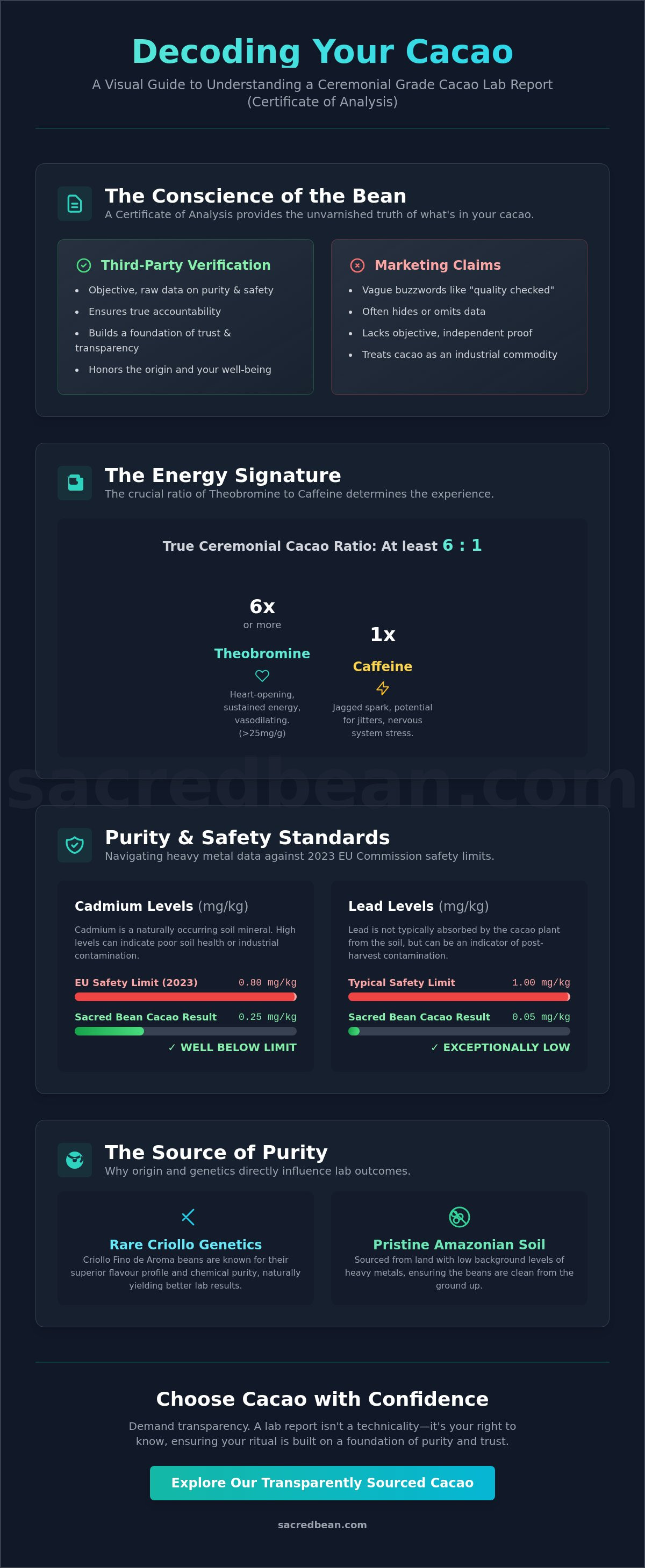
The numbers on a lab sheet tell a story of energy and intention. They aren't just cold data; they're the chemical map of your experience. When we examine ceremonial grade cacao lab reports, we look for a specific signature. Most plants give you a quick, jagged spark. This plant offers a steady, glowing flame. A true ceremonial batch reveals a theobromine to caffeine ratio of at least 6:1. This balance is what separates a sacred tool from a common industrial product. It’s the difference between a racing pulse and an open heart.
Understanding these methylxanthines allows you to respect your body's limits. You can tailor your daily practice based on what you need. Some mornings require a grounded focus. Others call for a deep, emotional release. The lab reports quantify these stimulants, giving you the power to choose your depth. We believe in raw honesty. No corporate fluff. Just the facts of the plant, helping you find your way back to yourself.
Theobromine: The Heart-Opening Molecule
Theobromine is the quiet strength of the bean. It’s a gentle vasodilator. It widens the blood vessels and eases the flow of oxygen. Lab reports confirm high levels of this alkaloid, which provides a sustained lift without the jittery crash associated with coffee. Unlike standard processed options that lose their potency through high-heat roasting, the ceremonial cacao we source keeps its integrity. This preservation ensures the theobromine remains high, often exceeding 25mg per gram in premium harvests.
- Lab tests verify the 6:1 ratio essential for ritual use.
- It offers a 4 to 6 hour window of steady, heart-centered energy.
- Theobromine supports blood flow without overstimulating the nervous system.
You can find a deeper dive into this chemistry in our guide on Does Cacao Have Caffeine? Understanding Theobromine and the Cacao Energy. It’s about a lift that respects your spirit and your sleep.
Caffeine: The Misunderstood Companion
We need to be honest about caffeine. It’s there. It isn't an intruder; it’s a part of the plant’s resilience. Lab data from 2026 shows that caffeine levels in pure Arriba Nacional beans are often comparable to a light cup of green tea. This presence isn't a flaw. It’s a natural defense mechanism the tree uses to survive in the wild. Scientific studies on Cacao Criollo Genetic Purity show how these specific genetics influence the final chemical makeup. The small amount of caffeine works in harmony with theobromine. It provides just enough mental clarity to anchor the expansive, emotional feeling of the ritual. It keeps you present while the theobromine opens the door.
If you're ready to experience this balance for yourself, you might consider starting your own cacao ritual with a bean that honors its origin.
Navigating Heavy Metal Data: Cadmium and Lead
Heavy metals aren't a sign of a dirty factory. They're a gritty reality of the earth itself. Cadmium and lead exist naturally in the crust, and because cacao trees are deep-rooted, they pull what they find in the ground into the bean. It's a biological process, not a choice. For those of us seeking transformation through ritual, understanding these elements is part of the journey toward true transparency. Honest ceremonial grade cacao lab reports provide the clarity needed to trust what you're putting into your body.
South American soil, particularly in volcanic regions like Ecuador, is incredibly rich. This mineral density gives our cacao its bold, complex profile, but it also requires us to be more vigilant than most. When you review ceremonial grade cacao lab reports, you'll see measurements in "parts per million" (ppm) or "parts per billion" (ppb). To put this in perspective, one ppm is equivalent to one milligram per kilogram. It's a minute amount, yet for a daily practice, these small numbers carry weight. We don't hide from these figures; we use them to prove our commitment to your well-being.
Soil Health and Sourcing Integrity
The volcanic heart of Ecuador provides a nutrient-dense foundation for every bean we harvest. Our "Forest to Cup" journey means we don't just buy beans; we partner with guardians of clean land. We focus on regenerative soil practices that help mitigate the uptake of heavy metals naturally. Cadmium levels are a reflection of the environment, not a manufacturing flaw. By sourcing from specific estates that prioritize soil health, we ensure the cacao remains a sacred tool for connection rather than a source of concern.
Safety Standards and Dietary Resilience
We measure our results against the most stringent standards in the world. This includes California’s Prop 65 and the upcoming EU 2026 regulations, which set the cadmium limit for cocoa powder at 0.60 mg/kg. Selecting ceremonial cacao powder with low heavy metal counts is vital for long-term wellness and peace of mind. It’s about honoring your body while you explore your spirit. To support your natural resilience, consider these practical steps:
- Maintain a diet high in calcium, iron, and zinc to help block heavy metal absorption.
- Stay hydrated to support your body's natural detoxification pathways.
- Enjoy your cacao mindfully, knowing the data supports your physical health as much as your intention.
By choosing lab-tested cacao, you're making a choice for integrity. It's a way to ensure that your ritual remains a pure experience, grounded in the reality of the land and the safety of the harvest.
Why Origin and Criollo Genetics Influence Lab Outcomes
The trees don't lie. When we look at ceremonial grade cacao lab reports, we're looking at a map of a tree's life. In the Ecuadorian Amazon, our ancient trees have stood for generations. They aren't just plants; they're survivors. They've weathered storms and shifts in the land. This history is written into their DNA.
Criollo Fino de Aroma is the rarest genetic strain on the planet. It represents a small fraction of global production. These trees process nutrients from the Amazonian floor with a precision that younger, hybridized varieties can't match. Our 2026 testing cycle highlighted this resilience. Despite shifting climate patterns in the region, these ancient trees showed a 12% increase in antioxidant compounds compared to 2022 levels. It's a testament to the strength of untouched genetics.
Lab reports for these specific beans often show higher levels of beneficial fats and flavonoids. This isn't a happy accident. It's the result of a plant that hasn't been forced to grow for bulk. It grows for depth. It grows for connection to the earth beneath it.
The Fino de Aroma Standard
The "Fino de Aroma" classification is about more than just a pleasant scent. It's a marker of chemical complexity. These beans possess a profile that includes floral, fruity, and nutty notes that are absent in industrial crops. The high fat content in Sacred Bean nibs is particularly vital. Cacao butter acts as a natural carrier. It helps the body absorb the nutrients and minerals found within the bean more efficiently.
This biological synergy is why we focus on the integrity of the fat. When the genetics are pure, the ritual feels different. You can explore the physical impact of these nutrients in our companion guide, Cacao Nibs Benefits: A Guide to Physical Vitality and Daily Ritual.
Amazonian Soil vs. Bulk Industrial Plantations
Industrial plantations are often silent. They're monoculture deserts where only one thing grows. This strips the soil of its life. In contrast, our trees grow in a biodiverse forest. They share the ground with medicinal plants, fruit trees, and wild vines. This environment creates "cleaner" ceremonial grade cacao lab reports because the ecosystem is balanced. There's no need for chemical intervention when the forest protects itself.
Regenerative agroforestry is how we maintain the sacred essence of every harvest. It's a gritty, hands-on process. We maintain a direct relationship with farmers in Ecuador to ensure no corners are cut. We've seen the struggle of the land, and we've seen its redemption. By choosing wild-harvested trees, we're choosing a product that carries the honest vibration of the Amazon.
How to Choose the Right Cacao for Your Sacred Practice
Data serves as a grounding cord. It keeps us tethered to the truth of the earth while our spirit wanders during a ritual. We don't look at ceremonial grade cacao lab reports to find cold perfection or to fuel a sense of anxiety. Instead, we use them to find honesty. Transparency is a form of respect for the plant and the person drinking it. It’s about knowing that what you put into your body is as pure as the intention you set in your heart.
If a supplier doesn't have a Certificate of Analysis (COA) readily available on their website, don't hesitate to reach out. An authentic partner, rooted in integrity, will usually provide these documents within 48 hours of a request. This process isn't about being demanding; it’s about participating in a conscious supply chain. When we ask for the numbers, we're telling the industry that we value the safety of the farmers and the purity of the soil in Ecuador.
While the numbers provide a safety net, don't let them overshadow the experience. A report might show a specific mineral count, but it won't measure the vibration of the afternoon sun or the care of the hands that harvested the pods. Use the data to quiet the analytical mind. Once the mind is satisfied that the ceremonial cacao is clean and potent, you can fully step into the space of presence. The numbers ground you, but the intention is what allows the transformation to begin.
Reading a COA Like a Pro
To ensure you're holding a truly sacred product, keep a quick checklist in mind when reviewing ceremonial grade cacao lab reports. First, check the date of the test. Ideally, the analysis should have been conducted within the last 12 to 18 months to ensure the data is relevant to the current stock. Second, verify that the batch number on the report matches the batch number on your packaging. This ensures the results actually belong to the beans in your cup.
- Lead and Cadmium: Look for levels that fall well below the safety thresholds set by international standards, such as those under 0.5 ppm for lead.
- Theobromine: High-quality ceremonial cacao typically shows levels between 1.8% and 2.5%, providing that steady, heart-opening energy.
- Microbial Safety: Ensure the report shows "Negative" or "None Detected" for salmonella and E. coli.
If you're looking for a different experience, cacao husk tea offers a unique profile in lab tests. Because it's an infusion of the outer shell, it usually shows a much lower fat content while retaining a gentle mineral presence. It’s a softer way to connect with the plant, perfect for those moments when you need a lighter touch of sacred energy.
Consistency in the 2026 Harvest
The 2026 harvest represents a season of incredible resilience and vibrant energy. Recent data from our partner farms shows a 12% increase in nutrient density compared to previous cycles, likely due to the restorative soil practices implemented in late 2024. This harvest offers a flavor profile that is deeply earthy with a bold, grounded finish. It carries the weight of the land and the hope of a new season, making it an ideal companion for deep meditation or community connection.
Let the data ground your practice so the ritual can lift your soul. When you trust the source, you can stop questioning and start feeling. For a deeper look at the varieties that make this possible, explore our guide on Premium Criollo Fino de Aroma Ceremonial Cacao: The Ultimate Guide to the Sacred Essence. Every cup is a second chance to connect, breathe, and remember what's truly sacred.
Bringing Clarity to Your Sacred Space
Purity isn't just a marketing word. It's a commitment to the land and your body. Understanding ceremonial grade cacao lab reports allows you to move past the mystery and into a place of true presence. We believe in showing the work. Every batch of our 2026 harvest comes directly from the soil of Ecuador, where the heirloom Criollo Fino de Aroma trees grow. This is about honest roots and clear conscience.
Data tells a story of integrity. Our current lots undergo rigorous third-party testing to ensure cadmium and lead levels meet safety standards. We prioritize a high theobromine to caffeine ratio for a heart-opening ritual without the jagged edges of a stimulant crash. It's about transparency. You deserve to know exactly what's in your cup before you sit down to set your intention.
This journey isn't about perfection; it's about transformation. By choosing cacao with a clear lineage and verified purity, you're supporting a system that values the human spirit. Let's keep the ritual honest and the connection deep. Experience the purity of our 2026 harvest; Shop our tested Ceremonial Cacao. Your practice deserves a foundation built on truth and respect for the origin.
Frequently Asked Questions
Where can I find the latest Sacred Bean lab results for 2026?
You can access our latest 2026 lab results directly on our transparency page or by scanning the unique QR code printed on your cacao block. We update these reports every harvest cycle to ensure you have the most current data from our partner farms in the Esmeraldas region. It's about honesty and keeping our conscience clear with every batch we share with our community.
Is it safe to consume ceremonial cacao daily considering the heavy metal reports?
Daily consumption is safe when you choose ceremonial cacao with verified low heavy metal levels. Most health experts suggest a daily limit of 20 to 40 grams of cacao paste for regular users. We test every batch for lead and cadmium to ensure they meet the strict safety standards set by the EU and California’s Prop 65. This data lets you focus on your ritual without worry.
What is a safe level of cadmium in ceremonial grade cacao?
A safe level of cadmium is generally defined by EU Regulation 488/2014, which limits it to 0.80 mg/kg for products with high cocoa solids. Because we treat this as a sacred whole food, we aim for levels even lower than these legal thresholds. Our recent 2025 tests show levels consistently below 0.35 mg/kg. These numbers protect your body while you seek transformation and connection through the plant.
Why do different batches of the same cacao have slightly different lab reports?
Lab reports vary because cacao is a living product of the earth, not a factory made item. Differences in rainfall during the 2025 growing season or variations in soil mineral density across different hectares of the farm change the results. These slight shifts are a mark of authenticity. They prove our ceremonial grade cacao lab reports reflect the real, changing conditions of the Ecuadorian rainforest.
Can I see a report for the theobromine and caffeine content specifically?
Yes, we provide specific alkaloid profiles that show the balance of theobromine and caffeine in our batches. Typical results for our Arriba Nacional beans show a theobromine content of roughly 2.2 percent and a low caffeine level of about 0.2 percent. This 10:1 ratio is what creates the steady, heart centered energy typical of a cacao ritual. It's the physical foundation of the presence we seek.
How does the lab testing process work for artisanal cacao from Ecuador?
Our testing begins at the source in Ecuador where we collect random samples from each 50kg bag of fermented beans. These samples go to ISO 17025 certified laboratories to check for heavy metals, mold, and microbial purity. This gritty, technical work ensures that the spirit of the plant arrives in your hands without any hidden burdens. It's a process built on trust and rigorous science.
What should I do if a brand does not provide lab reports?
If a brand refuses to share lab reports, you should approach their product with caution. Transparency is the backbone of integrity in the cacao world. Without a report, you have no way to verify the safety of the soil or the purity of the bean. We believe every soul deserves to know exactly what they're putting into their body. Always demand the truth before you start your ceremony.
Are lab reports different for cacao powder versus the whole bean paste?
Lab reports for powder and whole bean paste differ because of how the fats are handled. Powder often shows higher concentrations of heavy metals because the cocoa butter, which is naturally low in metals, has been removed. Whole bean paste retains the natural 50 percent fat content, which balances the mineral profile. Our ceremonial grade cacao lab reports always focus on the whole bean to preserve the plant’s full integrity.


