

What if the simple act of drinking could be a bridge back to your own soul? Most of us move through our days on autopilot, grabbing a quick stimulant without a second thought for where it came from or what it's doing to our spirit. You've likely felt that nagging sense of disconnect from the source of your food. It's a common struggle; research from 2023 suggests that 60 percent of people feel overwhelmed by contradictory health labels when trying to choose "superfoods." This confusion often leaves us stuck between processed powders and the true, grounded power of cacao beans.
We believe in a different way. We're here to help you cut through the noise and understand the honest journey from the Ecuadorian soil to your cup. You'll learn the genuine health benefits of this sacred seed and see why a 15 minute daily ritual can change the way you interact with the world. This is a guide to the bean-to-cup journey, designed to help you move beyond simple ingredients and toward a life of deeper intention and community connection.
Key Takeaways
- Learn why these sacred seeds are more than just an ingredient, offering a pathway to deeper presence and connection.
- Uncover the story behind the volcanic soil of Ecuador and the dedicated hands that harvest each pod with purpose.
- Discover why the rare Criollo variety is considered the gold standard for those seeking the purest expression of cacao beans.
- Understand the gentle, heart-opening energy of theobromine and how it nourishes both your physical body and your spirit.
- Move beyond simple consumption and learn how to integrate these seeds into a daily ritual that centers your heart and mind.
What are Cacao Beans? The Sacred Seeds of the Theobroma Tree
The story of What are Cacao Beans? begins with a seed that feels like a heavy secret. These fatty seeds are the heart of the fruit, the raw material we call cacao beans. Often referred to as the "Food of the Gods," they're much more than a simple ingredient. They represent a bridge to something deeper, a way to find presence in a world that often feels fractured and fast.
To see how this transformation begins from the tree to the bean, watch this helpful video:
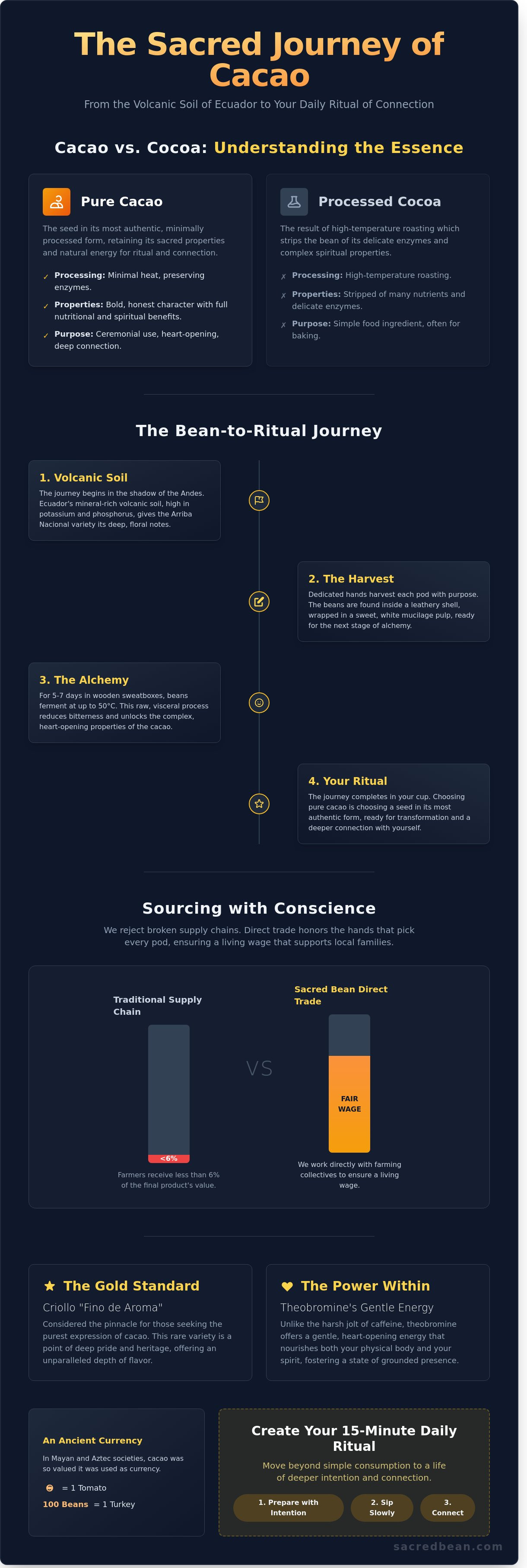
A cacao pod is a strange, beautiful thing. It features a leathery shell that turns bright shades of yellow, red, or purple as it matures. Inside, you find the cacao beans wrapped in a sweet, white mucilage pulp. This pulp is tart and tropical, a contrast to the deep, earthy flavor of the seed itself. In ancient Mayan and Aztec societies, these beans were so valued they served as currency. A single bean could buy a tomato; a hundred could buy a turkey. It was a lifeblood of trade and a vessel for ritual.
Theobroma Cacao: More Than Just a Plant
Theobroma cacao serves as a vital bridge between physical nutrition and spiritual presence. These trees are picky, thriving only in the "Cocoa Belt," a narrow band 20 degrees north and south of the equator where the air stays thick with humidity. In Ecuadorian culture, the Arriba Nacional variety is a point of deep pride and heritage. It's a connection to the land and the ancestors. For local communities, the bean represents a second chance, a way to honor the earth while providing for the family through honest, gritty work.
Cacao vs. Cocoa: Understanding the Essence
The difference between cacao and cocoa isn't just a spelling error. It's a matter of heat and soul. High-temperature roasting strips the bean of its sacred properties and delicate enzymes. We believe in minimal processing to keep the bean's natural energy intact. This results in "pure" cacao, a ritual-ready ingredient that retains its bold, honest character. When you choose ceremonial cacao, you're choosing the seed in its most authentic form, ready for transformation and connection.
The Journey of the Bean: From Ecuadorian Soil to Your Ritual
The story of our cacao beans begins in the shadow of the Andes. It's a land defined by fire and ash. Ecuadorian volcanic soil provides a mineral profile you won't find anywhere else. This terroir isn't just a marketing buzzword. It's the lifeblood of the Arriba Nacional variety. The soil's high potassium and phosphorus levels shape the bean's deep, floral notes. It's a gritty, honest foundation for a sacred experience. We don't just see dirt; we see the history of the earth providing for the soul.
Sourcing with Conscience
True quality starts with people. We believe in direct trade because it honors the hands that pick every pod. In many traditional supply chains, farmers receive less than 6% of the final product's value. We reject that model. By working directly with farming collectives in regions like Esmeraldas, we ensure a living wage that supports local families. This is why we call it "Sacred." The term applies to the community and the conscience behind the process, not just the seed. When you choose our ceremonial cacao, you're participating in a cycle of redemption and respect. Understanding the history and science of cacao helps us appreciate how these ancient traditions survive through ethical partnerships.
The Alchemy of Fermentation
Fermentation is where the magic happens. It's a raw, visceral process. The beans sit in wooden sweatboxes for five to seven days. You can feel the heat radiating from the piles as temperatures naturally climb to 50 degrees Celsius. The scent shifts from a sharp, vinegary sting to a rich, complex aroma of tropical fruit and earth. This phase is essential for reducing the natural bitterness of the cacao beans. It unlocks the heart-opening properties we seek in ritual. Just as the bean must sit in the dark and heat to shed its bitterness, we often find our own growth through the fire of struggle. It's a transformation from something raw into something refined.
After fermentation, the seeds move to the drying mats. They soak up the equatorial sun for several days. This slow process preserves the life force of the seed. We don't rush it with industrial dryers. We let the rhythm of nature finish the work. The result is a bean that carries the energy of the sun and the strength of the soil. It's ready for the workshop, and eventually, your cup. If you're ready to start your own practice, you might consider how a daily cacao ritual can ground your morning.
Varieties of Cacao: Why Criollo Fino de Aroma is the Gold Standard
Not every seed holds the same spirit. When we talk about cacao beans, we are looking at a spectrum that ranges from industrial commodity to sacred medicine. Most of the world's supply is grown for efficiency and high yields, but our path leads us elsewhere. There are three primary genetic families of cacao: Criollo, Forastero, and Trinitario. Each has a different story to tell, and for those of us seeking a deeper connection, the choice of bean changes everything.
Most commercial products rely on Forastero because it is hardy and produces a massive amount of fruit. It covers roughly 80% of global production. Then there is Trinitario, a natural hybrid that offers a middle ground. But the Criollo bean is the ancient soul of the plant. It is fragile, sensitive, and incredibly rare. It represents less than 5% of all cacao grown on the planet. Understanding the Origins Of Cocoa And Its Spread helps us see how these varieties evolved and why the Criollo remains the heirloom of the heart.
Criollo vs. Forastero: A Comparison
The difference between these two is the difference between a mass-produced snack and a hand-poured ritual. We choose the difficult path because the results are transformative. Forastero is built for the factory; Criollo is grown for the soul.
| Feature | Criollo (Ritual) | Forastero (Industrial) |
|---|---|---|
| Flavor Profile | Delicate, floral, nutty, and fruity. | Strong, bitter, and acidic. |
| Global Rarity | Less than 5% of production. | Roughly 80% of production. |
| Primary Use | Ceremonial rituals and fine flavor. | Bulk candy and industrial snacks. |
Industrial manufacturers favor Forastero because its bitterness can be masked with heavy roasting and refined sugar. Criollo cacao beans don't need to hide. They carry a natural complexity with subtle notes of jasmine and wild berries that only emerge when treated with respect and patience.
The Mark of Quality: Fino de Aroma
The International Cocoa Organization uses a specific classification for the best of the best: Fino de Aroma. This isn't just a fancy label; it's a sensory standard that only a small fraction of the world’s harvest ever reaches. In Ecuador, our beans are nurtured to meet this standard, ensuring they possess the rich, multi-layered aroma required for a true cacao ritual.
High-quality beans show their integrity through physical cues. When you handle a properly processed bean, it should have a distinct "snap" when broken, a sign of perfect fermentation and drying. The surface should have a slight, healthy shine, reflecting the natural fats and minerals within. This quality supports your intention. It allows the body to receive the nutrients without the jittery crash of lower-grade, over-processed alternatives. It is a grounded, honest experience from the first breath of its aroma.
The Benefits of Cacao Beans: Nourishing Body and Spirit
Eating cacao beans is an act of reclamation. It is a choice to step away from the processed world and return to something gritty and honest. These seeds are a nutritional powerhouse, packed with more antioxidants than almost any other food on the planet. They carry high levels of iron and zinc; minerals that ground us when life feels chaotic. Most importantly, they are the world's highest plant-based source of magnesium. This isn't just a label on a supplement bottle. It is a vital key to human transformation.
Whole cacao beans offer a grounded experience that isolated extracts or processed bars simply can't match. When we consume the bean in its entirety, we honor the complex synergy of its fats and fibers. This slow release of nutrients ensures the body isn't overwhelmed. It is a steady, resilient energy that supports a day of purpose rather than a fleeting spike in blood sugar.
Theobromine: The Heart-Opener
The energy of cacao is different from the sharp, jagged edge of a morning coffee. While coffee relies on caffeine to stimulate the nervous system, cacao beans contain theobromine. This alkaloid works as a vasodilator, widening blood vessels and allowing the heart to pump with a quiet strength. It creates a physical sensation of openness. You can feel the warmth spreading through your chest; a gentle invitation to breathe deeper. Theobromine is the gentle teacher of the plant world, guiding us toward alertness without the restless jitters. It supports a focused mind and a softened spirit, making it easier to connect with ourselves and those around us.
Magnesium and Mindfulness
In a world defined by stress and hurry, our bodies often run dry of magnesium. Research from the Journal of the American Osteopathic Association suggests that nearly 50 percent of people are deficient in this crucial mineral. This lack often manifests as tension, anxiety, and restless nights. Cacao provides a sacred remedy. By relaxing the muscles and calming the nervous system, the magnesium in these beans creates the physical space needed for deeper meditation. It is easier to set an intention when your body isn't screaming with tension. Incorporating organic cacao nibs into your daily routine is a simple way to access these benefits. These small fragments of the bean act as a reminder to stay present, even in the middle of a busy day.
Cacao also supports the release of bliss molecules like anandamide. This neurotransmitter is named after the Sanskrit word for joy. It binds to the same receptors as certain compounds in the brain that regulate mood and pain. This isn't a synthetic high. It is a natural shift toward emotional resilience and hope. It helps us see the beauty in the struggle and the potential for a second chance.
Ready to bring this ritual into your own home? Experience the grounding power of our ceremonial cacao and start your journey toward presence.
Integrating Cacao Beans Into Your Daily Ritual
Most people are used to grabbing a snack on the run. We eat to fuel up or to distract ourselves from the noise of the day. Ritual changes that. It's the moment you decide to stop running and start listening. When you bring cacao beans into your home, you aren't just stocking a pantry. You're inviting a story that began in the rich volcanic soil of Ecuador into your own private space. This is about turning a mindless habit into a sacred pause.
Using these seeds is an act of reclaiming your time. You can place whole beans on an altar as a reminder of your connection to the earth. You can grind them for a drink. The goal isn't perfection. The goal is presence. We believe that every time you choose to slow down, you're practicing a small form of rebellion against a world that demands you always be "on." It's a way to find redemption in the quiet moments of a busy life.
From Nibs to Elixirs
Our mornings often start with a frantic rush. We suggest swapping that chaotic energy for a warm cup of ceremonial cacao powder. It's a grounded way to face the day ahead. If you want to experience the bean's pure texture, try mindfully chewing on raw nibs. Notice the initial bitterness and the subtle earthy finish. For a quiet evening, cacao husk tea provides a gentle ritual. It's a lighter infusion that honors the whole plant, offering a soft landing after a long day of work.
A Simple Ritual for Presence
You don't need an elaborate setup for your first ceremony. A quiet corner or a favorite chair is plenty. Follow these three steps to begin your practice:
- Set an intention. Take a breath and ask yourself what you need today. It could be clarity, patience, or just a moment of peace.
- Breathe with the aroma. Before you drink or eat, hold the cacao close. Let the deep, roasted scent ground your senses in the present moment.
- Sip with gratitude. Acknowledge the journey of the cacao beans from the farm to your hands. Think of the hands that harvested them and the sun that dried them.
There's no wrong way to connect. You don't need to follow a script or use certain words. As long as your heart is open, the connection is real. Cacao isn't a magic cure. It's a guide. It's a humble seed that creates a bridge, leading you back to your own inner wisdom and the resilience you've always had. Use this ritual to remember who you are when the world isn't watching.
Begin Your Ritual of Presence
Choosing a deeper path starts with what you hold in your hands. These seeds aren't just a botanical curiosity; they're a bridge to a slower, more intentional way of living. When you choose premium Criollo Fino de Aroma cacao beans, you're selecting a rare variety that represents less than 5% of the global harvest. It's a choice that honors the small-scale Ecuadorian farmers we partner with directly to ensure transparency and fair exchange. This isn't a sterile corporate transaction. It's a grounded mission of recovery and redemption that seeks to transform lives at both ends of the journey.
We've seen how a simple daily ritual creates space for honest connection and spiritual hope. It's about finding beauty in the grit and making room for genuine transformation. Every cup reflects the resilient spirit of the communities behind it. You're invited to step away from the noise and into a practice that nourishes your soul. Take a breath, set your intention, and let the warmth ground you in the now.
Experience the ritual with our authentic Ceremonial Cacao
The journey toward presence is a shared one, and we're glad you're here.
Frequently Asked Questions
What is the difference between cacao beans and cocoa beans?
Cacao beans are the raw, unrefined seeds of the Theobroma cacao tree, while cocoa beans undergo high heat roasting. This industrial process often destroys many of the 600 chemical compounds found in the raw state. We keep the bean close to its origin to preserve the nutrients and the spirit of the plant. It is about transformation without losing the soul of the seed.
Can you eat raw cacao beans straight from the bag?
You can eat raw cacao beans straight from the bag for a bitter, earthy snack that grounds the senses. These seeds offer a crunchy texture and a deep, unadulterated flavor that connects you directly to the Ecuadorian soil. Most people find that eating 5 to 10 beans provides a quick moment of presence during a busy day. It is a simple ritual for a gritty world.
Do cacao beans have caffeine?
Cacao beans contain a small amount of caffeine, but the primary stimulant is a compound called theobromine. While a 28 gram serving has about 12 milligrams of caffeine, it provides 250 milligrams of theobromine. This creates a steady, heart centered energy rather than the jittery spike often associated with coffee. It is a gentle lift that supports focus and a calm conscience.
How many cacao beans should I eat for a ceremonial effect?
A standard ceremonial dose is typically 42 grams of cacao beans or paste. This specific amount has been used in traditional rituals to open the heart and deepen meditation. For a daily ritual, we suggest starting with 20 to 28 grams to find your personal balance. Take a moment to set an intention as you prepare your dose, honoring the journey of the seed.
What are the health benefits of eating cacao beans daily?
Eating cacao beans daily provides a high concentration of antioxidants and magnesium for heart health. Research from the American Heart Association indicates that the flavonoids in cacao help lower blood pressure in 80 percent of study participants. It also boosts your mood by encouraging the production of serotonin and anandamide, often called the bliss molecule. This daily habit fosters a sense of grounded hope.
How should I store my cacao beans to keep them fresh?
Store your beans in a cool, dry, and dark place like a pantry shelf to maintain their integrity. Exposure to oxygen or moisture can degrade the delicate fats and flavors within 90 days. Use an airtight glass jar to keep the seeds fresh and potent for up to 1 year. Proper storage is an act of respect for the farmers who harvested these sacred seeds.
Why is ceremonial grade cacao more expensive than regular cacao beans?
Ceremonial grade cacao is more expensive because it prioritizes ethical sourcing and labor intensive traditional methods. These beans often grow in biodiverse forests in Ecuador where farmers earn 50 percent more than the standard fair trade rate. This investment supports the community and ensures the sacred quality of every seed. We believe in paying a price that reflects the true value of human labor.
Are cacao beans vegan and gluten-free?
Pure cacao beans are naturally vegan and gluten free. We ensure our seeds are processed in facilities that don't handle wheat or animal products to maintain their purity. This allows the sacred plant to be accessible to everyone seeking a moment of connection and transformation. It is a clean, honest way to feed your body and your spirit without any hidden additives or corporate fillers.


